
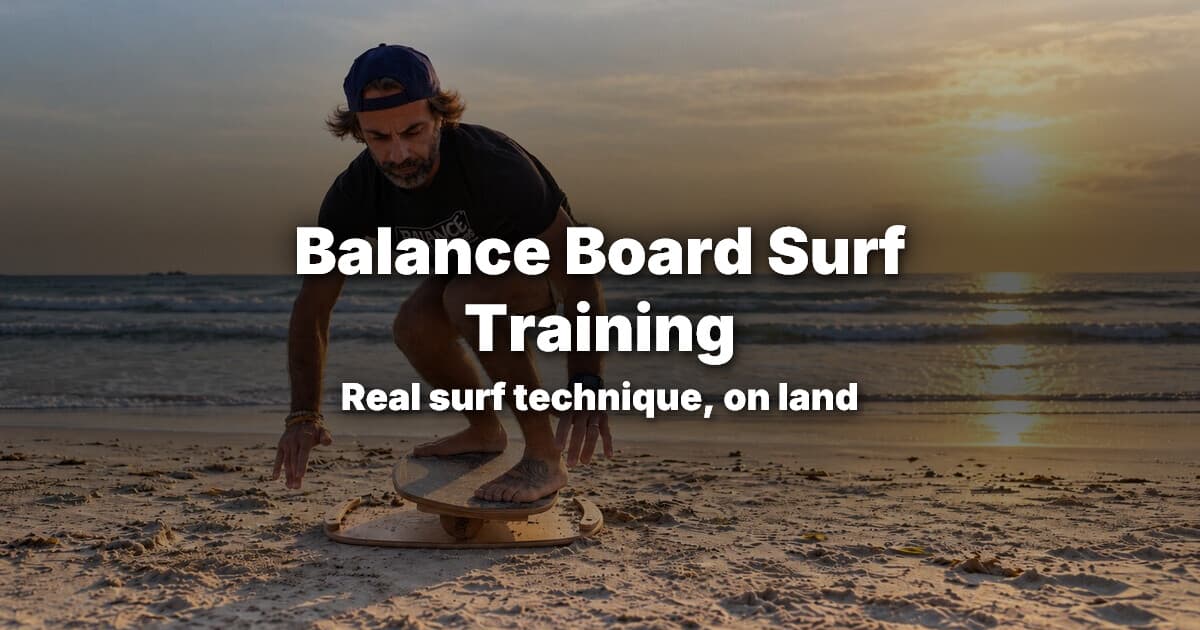
Balance board surf training is one of the most effective ways to train your surf technique on land. If you love surfing, you already know how important consistency is to improve your performance, but distance from the ocean and unstable conditions often keep you out of the water more than you’d like.
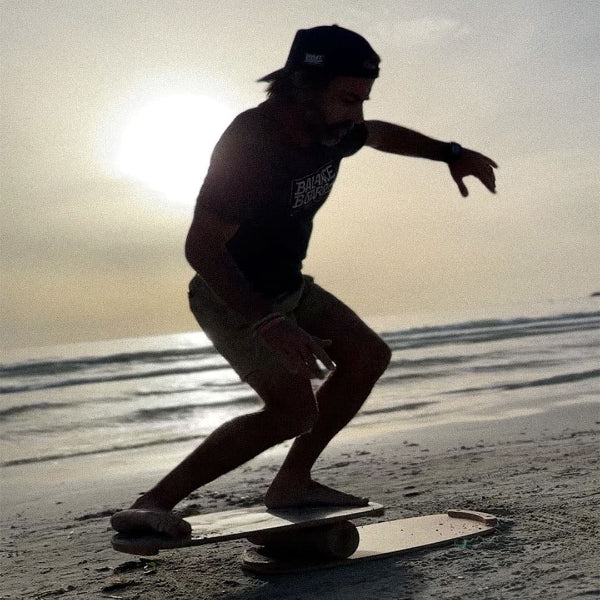
Image above: coach Daniele Tassoni on the Balance Board Pro while performing the pop-up on the balance board.
A balance board lets you replicate surf movements on land, so you can improve your performance in the water while staying in good shape.
Training on the unstable surface of a balance board is the core of balance board surf training: out of the water you recreate the same micro-adjustments, weight shifts and core activation you use on a moving surfboard. You work on reactive balance, body control and dynamic stability — three key elements that make the difference for your pop-up, stance and maneuvers.
💡 This is what makes a balance board a concrete tool to improve your surfing even when you can’t get into the ocean: it doesn’t “pretend” to be surfing, it trains the same motor patterns.
A balance board surf session is done on a deck placed on a roller. The unstable surface doesn’t just activate stabilizer muscles — essential to keep your balance — it also builds strength, endurance and coordination. Because you are simulating real surf movements, you can improve both technique and performance before even touching the water, so you’re ready to give your best once you’re back on the waves.
💡 It doesn’t matter what your level is: a balance board raises the bar of your training. Period.
What are the benefits of balance board training?
A balance board comes with a lot of benefits.
Balance board surf training is useful because it trains the same motor patterns of surfing even when you’re out of the water.
The four key benefits are:
- Reactive balance: the unstable surface develops the stabilizer muscles of your core and legs, essential to control the board in the critical sections of the wave
- Functional strength: it activates several muscle groups at once, mirroring the physical demands of pop-up, bottom turn and maneuvers
- Proprioception and coordination: it improves your ability to feel and correct your body position, essential to react to changing wave conditions
- Technical awareness: training forces you to read and understand your movement, correct mistakes and make your surf technique more precise.
In short: a balance board doesn’t “simulate” surfing, it trains the same skills you need in the water. Of course, a real wave is less predictable and a lot more unstable, but the board remains a solid ally to work on the main movements — paddling included.
Stretching and mobility: what you really need before and after surfing
Always spend a few minutes on surf-specific mobility.
Make it intentional: use a mat with reference lines such as the Surfing mat, so you can check stance, alignment and foot placement just like on your surfboard.
Before getting in the water, a surfer will work on:
- Dynamic mobility for shoulders and scapulae (arm circles, scapular push-ups)
- Hip opening + rotation work (hip openers, dynamic knee-to-chest)
- Reactive core activation (dead bug, anti-rotation work)
- Light dynamic leg stretching (quad stretch, hamstring sweeps)
- Pop-up simulation to prepare timing and coordination
A balance board calls many muscle groups into action: paddling out stiff means increasing your risk of injury.
A dynamic warm-up and a focused cool-down complete the circle of your balance board surf training.
Which muscles does surfing work?
Remember this: “a good surfer is, first of all, a good athlete” (cit. Daniele Tassoni). Surfing trains pretty much your whole body, but the muscles that matter most are these:
- Back and shoulders (latissimus dorsi, trapezius, deltoids): they’re the engine of your paddling
- Deep core (obliques, transverse abdominis, multifidus): stability during pop-up, stance and maneuvers
- Glutes and hips (gluteus medius and maximus, hip flexors): board control and rotation
- Legs (quadriceps, hamstrings, calves): absorbing the wave, compression and extension
- Forearms: grip and endurance during long paddling phases
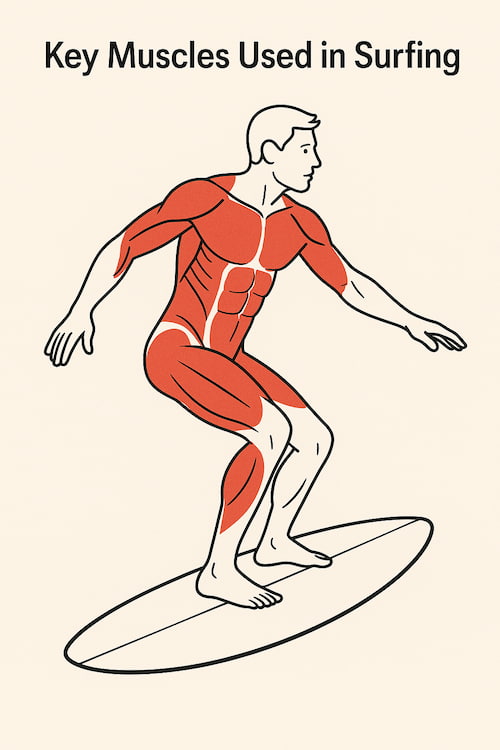
In short: surfing is a full-body sport, but everything revolves around three key areas — shoulders, core and hips — because they determine speed, stability and maneuverability on the wave.
🏄♂️ Coach’s tip
If you want to make your warm-up more precise, use a mat with reference markers such as the Surfing mat.
It lets you check stance, foot angle and alignment exactly like on your surfboard.
Perfect to simulate pop-ups, torso rotation and all those technical details that really matter in the water.
Video above: Francisco Anglani Cornielle, 🏆 European Champion U14 and rising star of European surfing, training on land on the Surfing mat.
How a balance board works
Balance board surf training is built around targeted and creative exercises you can plug into your training routine. The goal is to push your limits beyond “standard” workouts and turn every session into a unique, stimulating experience that brings you even closer to your passion for surfing.
The first steps of balance board surf training are about simply standing on the board and staying balanced while it rolls over the roller. This unstable surface simulates what you feel in the water on a board that is never fixed, but constantly moving with the waves. From the very first movements your core, legs and back muscles switch on, because every shift requires your whole body to work in order to keep the board off the ground.
Once you’re comfortable on the board, you can start progressing to more surf-specific exercises and simulate maneuvers such as take-off, bottom turn and cutback.
Tips for beginners using a balance board
If you’ve never used a balance board before, it’s important to follow a few basic tips.
You love surfing and you’re looking for a way to improve your performance even out of the water? Your answer is balance board surf training — the perfect dry-land workout to get more out of your sessions. Start with simple exercises and don’t force complicated maneuvers right away: build step by step, progression after progression, flow after flow. That’s how you improve for real without breaking the learning rhythm. Focus on maintaining your balance and improving stability.
It can help to start on a soft surface, such as a rug or yoga mat. This makes the balance board more stable and gives you time to get used to the movements: the mat slows the roller down and makes your first steps on the board easier. As you get more confident, you can move to harder, smoother surfaces.
Finally, make sure you do some light stretching before your session, with surf-specific exercises using a mat with reference lines as if you were on your surfboard. Bodyweight work is fine too — what matters is moving. As you’ve seen, balance board training involves many different muscles that need to be properly warmed up to reduce the risk of injury.
💡 Handcrafted Balance Boards by Balance Board Pro
Hand-shaped fiberglass boards tested by professional riders.
👉 Discover the collection
The best balance board exercises for surf training
There are many balance board exercises that can help you improve your skills in the water. One of the simplest and most effective is static balance: step onto the board and try to maintain your balance for as long as possible.
Another key exercise is the pop-up. With coach Daniele Tassoni’s tips you can follow a step-by-step simulation of the pop-up and the full take-off movement:
🏄♂️ Coach’s tip
Always remove the roller before trying any advanced flow-trick with the board flat on the ground — even something as simple as a jump onto the board. Test the exercise without the roller first and, once your coordination is solid, you can add the unstable surface. To build proprioception, you can even close your eyes during the trick and then check where you land on the board. Once you land, freeze and then open your eyes to check your foot position.
1️⃣ Without roller – learn the basic movement
Lie on your stomach in front of the board and jump up with both feet, landing just before the board. The goal is not to “do the pop-up”, but to understand where your feet land and test your hip mobility.
2️⃣ With roller – land with your feet before the board 📹
Lie down on your stomach again in front of the board and jump up with both feet, still landing just before the board. The goal is not to “do the pop-up” but to hold the paddling posture, feel how your feet move and find the correct position for the dry pop-up.
Video above: coach Daniele Tassoni coaching a student through a surf flow pop-up on the balance board with roller during Surfweek Meetup 2025.
When the movement feels clean, repeat it trying to land with both feet fully on the board, in a horizontal stance. This is where you see whether your body can actually reach the board in a stable position.
3️⃣ With roller – full pop-up execution 📹
Video above: coach Daniele Tassoni coaching a student through a surf flow pop-up on the balance board with roller during Surfweek Meetup 2025.
If the first two steps are solid, bring the roller back in. Simulate your paddling: chest on the board, back muscles active, chin up. Then perform an explosive pop-up, landing on the board and keeping your balance on the unstable surface — just like in the video below (Daniele pops up regular, left foot forward).
Coach Daniele Tassoni on the Balance Board Pro while performing the pop-up on the balance board.
How to integrate a balance board into your training
You can start by adding 10–15 minutes of balance board work per day to see your first improvements, then gradually increase the length of your sessions. At the beginning you can use the balance board mainly as a warm-up; over time it can become the main part of your training, combined with strength and cardio work.
For example, you can do a circuit with a series of exercises on the balance board followed by a run, jump rope session or weight training. This combination will help you improve not only balance and coordination, but also strength and endurance.
Try to keep your sessions varied so your training stays dynamic, stimulating and non-repetitive. Once you have full control of the board, you can add new maneuvers and creative variations to challenge yourself every day, keep motivation high and get the most out of your training.
Useful accessories for balance board surf training
For balance board surf training, the first thing you need is a board with a roller. There are many options on the market, but the smart choice is to focus on well-tested, reliable tools made with sustainable materials. Choose Italian-made materials and artisanal processes. Stay away from low-cost production models that sacrifice quality, durability and any real respect for people and fair competition.
Beyond the board itself, there are a few accessories that can make your training much more effective. The first is an anti-slip mat: it increases safety, prevents unnecessary slipping and gives you a stable surface to move on. If it has surf-related graphics — like the Surfing mat — the advantage doubles: you can also work on technical exercises for pop-up, stance and weight control.
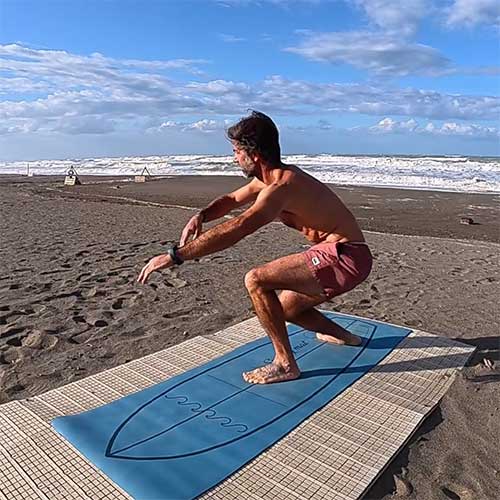
In the photo: coach Daniele Tassoni on the Surfing mat while performing a pop-up.
To increase intensity you can add ankle weights: more load on your legs, more specific strength and more stability once you’re back in the water.
Another useful tool is a resistance band: it adds resistance to your movements and lets you simulate rotations, weight shifts and stance changes very similar to what you do on a surfboard. By looping it around the board and your feet you can create variations that train strength, control and proprioception.
Surfskate vs balance board: the third pillar of surf training
Alongside the balance board and Surfing mat there’s another tool that really completes your dry-land surf training: the surfskate.
It’s the board that lets you replicate curves, rotations and smooth surf-style movements… but on asphalt. Perfect to work on technique, pump, line reading and weight transitions.
We talk in detail about it here:
👉 https://blog.balanceboard.pro/it/blog/surfskate-surfing-waves-on-asphalt
Working with balance board, Surfing mat and surfskate creates a complete training triangle: stability + technique + flow of movement. This is how you take your surf training out of the water and to a level you can actually feel in the lineup.
Real results from surfers who use a balance board
Many surfers who have added a balance board to their training have already seen the benefits of balance board surf training and noticed a clear improvement in their performance:
✅ Marco, 35, started using a balance board to improve his balance and strength. After just a few months of training, he noticed a significant improvement in his stability and his ability to perform more complex maneuvers in the water.
✅ Laura, a beginner surfer, found the balance board extremely useful. Before using it, she struggled to keep her balance on the surfboard. After integrating the balance board into her daily training, she saw a big improvement in her ability to stay on her feet and perform basic maneuvers.
✅ Luca, an experienced surfer, uses the balance board to stay in shape during winter, when surf conditions are less consistent. Thanks to balance board surf training he keeps his fitness level high and continues to refine his technique, so he’s always ready for good sessions when the conditions turn on.
Discover Fitsurf, our surf training partner
If you really want to level up, Fitsurf Training is the natural choice. It’s not generic fitness disguised as surf training: it’s a method built around the real gestures you use in the lineup — take-off, weight management, rotations, balance, reactivity and core stability. As coach Dario Nuzzi from Fitsurf explains: “We work on the surfer’s body, not on some idealized ‘fitness body’.”
By combining balance board work with the Surfing mat, as seen at Liguria Active Day 2025 with Gazzetta dello Sport, training stops being just theory: it becomes immediately more effective, more technical and closer to the sensations you’re looking for in the water. That’s where you start seeing real progress.
Are you ready to add a balance board to your training?
Ready to take this seriously?
A balance board is not “just another piece of gear”, it’s the fastest way to bring on land the same movement patterns you use in the water: reactive balance, weight control, hip and core stability. If you use it consistently, your body learns faster and your surfing changes: cleaner pop-ups, smoother lines, more control when the wave pushes.
Whether you’re starting from zero or already experienced, one thing makes the difference: actually doing the work. The board is there for that. Now it’s on you.
If you haven’t tried balance board surf training yet, this is the moment to start and integrate it into your daily routine, beginning with simple exercises and progressively increasing difficulty. You’ll feel the benefits in your body — and in your mind — in a way that’s simple, natural and fun.
Don’t wait. Get yourself a balance board and start training now.