How to Stimulate Psychomotor Development from an Early Age
With a Kids Balance Board: features, benefits, and plenty of ideas to help little ones have fun while supporting their psychomotor development with this valuable tool also recommended by Montessori.
What is a balance board?
The balance board, available in different materials, is a useful tool for dryland training such as surf training on land and for fitness. It consists of a flat wooden board resting on a roller.
This board is extremely useful for physical fitness and health, while also being a fun tool that stimulates proprioception. Born in the circus environment in the 1950s, it has significantly evolved over time. Today it is an essential tool to develop, improve, and train balance—and it allows the more daring to try freestyle tricks.
Kids balance board: what really changes
The kids balance board is not just a smaller version of the classic board with a roller. It’s a tool designed from scratch for children: a half-moon shaped, curved and stable board that rests directly on the ground.
This design eliminates unpredictable roller movements and drastically reduces fall risk, making it safer and more suitable for the developing coordination of young children.
Important: safer does not mean “no supervision required.” Use always requires active parental supervision.
The half-moon shape allows controlled oscillation:
- enough movement to stimulate balance, proprioception, and strength
- enough stability to avoid rotations and unmanageable dynamics
It’s the correct way to introduce children to unstable-surface sports without exposing them to unnecessary risks, while respecting their growth and motor development.
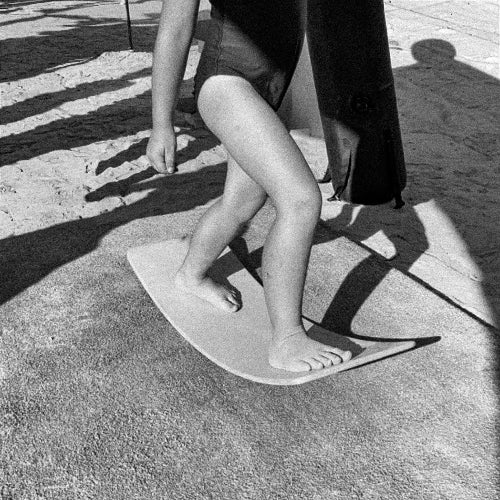
Image above: Kids balance board without roller, half-moon shape.
The traditional balance board has become popular among professional athletes who benefit both mentally and physically. The kids version—inspired by the Montessori method—is spreading among younger children thanks to its ability to support psychomotor development while making movement fun.
💡 Handcrafted Balance Boards by Balance Board Pro Handmade in Italy by a craftsman 👉 Discover the collection
From the Montessori method to a multifunctional tool
The kids balance board is often incorrectly called a Montessori board, although it is not a Montessori material. Montessori tools are designed for a single, clear, defined purpose for the child.
Unlike Montessori materials, the kids balance board is not a “single-function” object: it’s a preparatory tool that enables many different activities—from physical movement to creative play.
In addition to improving balance, learning and concentration, children can unleash creativity. The board can become a step stool, a slide, a rocker, or even a prop within imaginary worlds.
Montessori toys follow strict principles:
- targeted design with a specific educational purpose
- suitable for outdoor use to promote creativity
- made from natural materials—wood, fabric, metal
- enable self-correction and independent learning
The kids balance board aligns with all of this, while going further: it encourages physical activity, imaginative play, creativity, and supports 360° physical and mental growth.
What shape should a kids balance board have?
A kids balance board, unlike the adult version, is a curved wooden board without a roller.
The Balance Board Pro Kids Board measures 75×26 cm, weighs 1.6 kg, and supports up to 100 kg. Handmade by a craftsman, it’s made from seven layers of maple wood with a total thickness of approx. 1.05 cm.
Maximum height from the ground is about 12 cm. Easy to store thanks to its compact size, suitable for children’s height range and perfect even for their bedroom. Solid and safe.
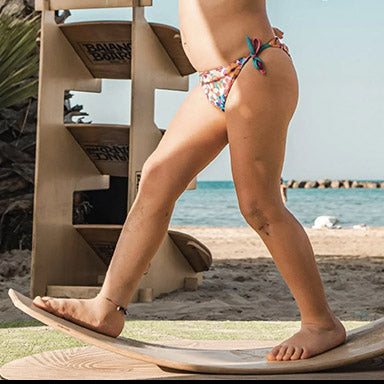
💡 Handcrafted Balance Boards by Balance Board Pro Handmade in Italy by a craftsman 👉 Discover the collection
Benefits of the kids balance board
Using a kids balance board provides numerous benefits:
✅ Improves balance The child develops greater stability and overall physical coordination.
✅ Strengthens the core Keeping balance requires activation of core muscles, supporting strong and stable physical development.
✅ Enhances coordination skills Standing on a dynamic surface forces continuous micro-adjustments, improving motor skills and spatial awareness.
✅ Boosts concentration Balancing on the board requires focus—this trains attention and mental control.
✅ Promotes physical activity It helps children stay active, away from screens and sedentary routines.
✅ Stimulates proprioception (kinaesthesia) Children learn to perceive their body in space and sense muscle activation without visual cues—essential for motor control and a key focus in physiotherapy.
💡 Proprioception is present as early as the seventh month of fetal development.
How to use a kids balance board?
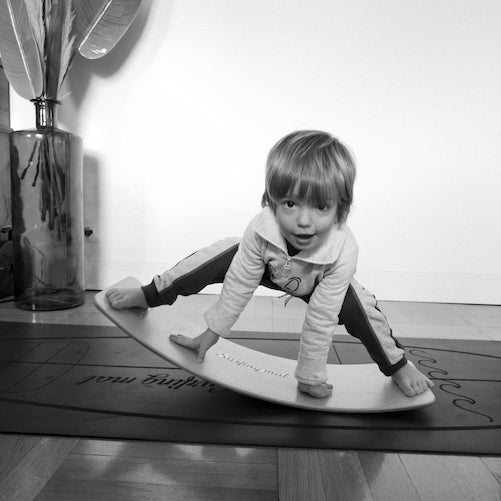
Kids can use the balance board standing, sitting, or kneeling. Each position provides benefits because the body interacts with an unstable support surface.
Designed to improve balance, it mixes play with the development of coordination and strength. It enhances motor skills, focus, posture, muscle development, and body awareness.
Games to play with a kids balance board
Inspired by Montessori balance concepts, the board is not a one-directional toy. It offers a wide range of play variations that stimulate curiosity and attention. Here are some ideas:
▶️ Adventure challenges
Invite your child to imagine tackling obstacles in a fantasy landscape—creativity + balance.
▶️ Rocking boat
Ask them to pretend they’re on a boat, rocking back and forth—great for coordination and imaginative play.
▶️ Animal safari
Have your child imitate animals while finding balance—fun + movement.
▶️ Tightrope walker challenge
Flip the board upside down and encourage slow walking across—focus + balance + new perspective.
▶️ Dance on the board
Play music and dance together while maintaining balance—kids love it.
▶️ Obstacle course
Create a 3–4 step course with one stage on the board—agility, motor skills, and problem-solving combined.
▶️ Yoga and stretching
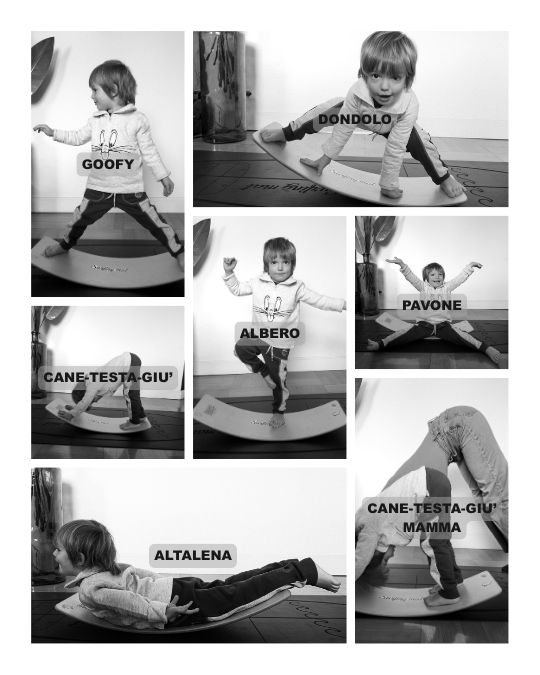
Image above: Noah (almost 3 years old) trying yoga poses on the kids balance board
Kids can also practice yoga just like adults. Try simple poses such as downward dog, swing, peacock, butterfly, or tree. These improve flexibility, awareness, and provide a calming effect.
Ready to give your child a stimulating new experience? Get them a balance board and let them enjoy the benefits of this fun, valuable tool for psychomotor development.
FAQ – Kids Balance Board
1) From what age is a kids balance board recommended? Is it really safe?
It’s designed for the 12–36 months range and beyond, thanks to the half-moon shape that rests on the ground and eliminates roller rotation. It’s more stable and predictable, ideal for developing coordination— but always requires active parental supervision.
2) What psychomotor development benefits does it really offer?
It improves balance, coordination, core strength, posture, proprioception, focus, and reduces sedentary habits. Controlled oscillation stimulates continuous micro-adjustments, activating deep muscles and motor-control pathways.
3) Why is it associated with Montessori if it’s not an original Montessori material?
Because it follows key Montessori principles: natural materials, freedom of movement, creativity, and self-correction. However, it is not an official Montessori tool. Unlike monofunction toys, the balance board is multifunctional.
4) How to choose the right kids balance board? Do size, shape, and materials matter?
Yes. A kids balance board should be:
- curved and roller-free
- lightweight yet durable
- proportioned to the child’s height
The Balance Board Pro version (75×26 cm, 1.6 kg, 7-ply maple, 100 kg capacity) is designed for safety, ease of use, and daily play.
5) What games can children play with a balance board?
It can be used:
- standing
- sitting
- kneeling
It becomes:
- a rocker
- a slide
- a bridge
- an animal-movement prop
- a yoga platform
- a dance board
- part of obstacle courses
The value lies in its variability.
6) Does it really improve balance and proprioception?
Yes. Controlled oscillation develops proprioception, essential for posture, coordination, and fluid movement. It is also widely used in physiotherapy and early motor development programs.