
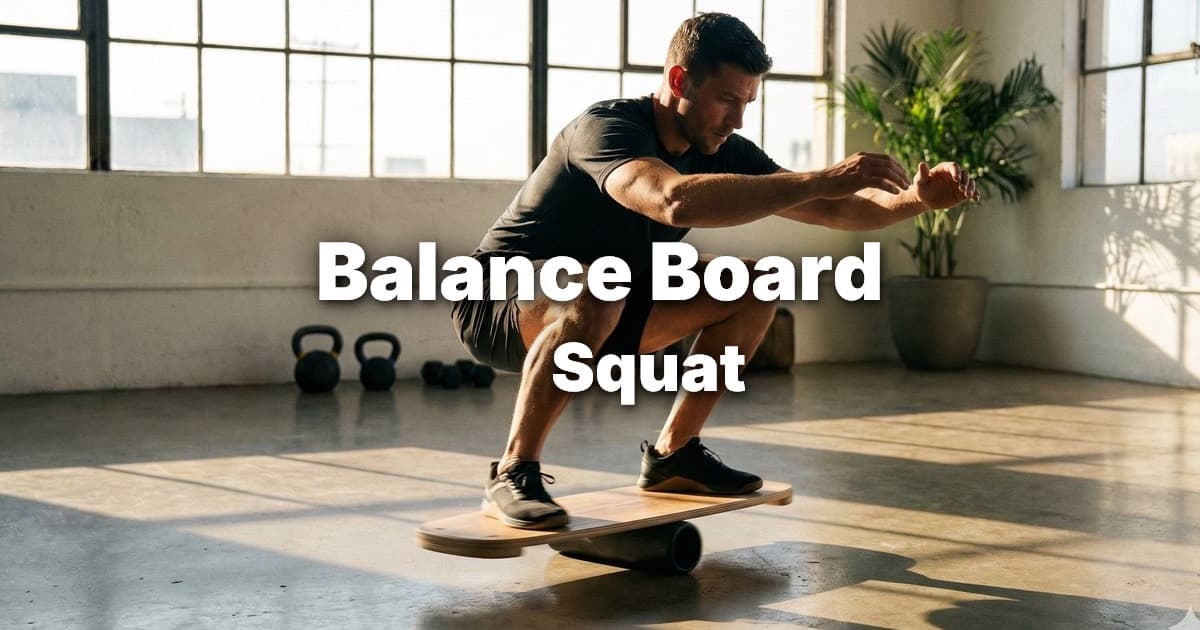
Balance Board Squat: Complete Technical Guide, Benefits and 6-Week Training Program
The balance board is the perfect tool for any sport and fitness level. It adds an extra layer of challenge to your workout, sharpens your proprioception and drives deeper core engagement — all from your living room, backyard or gym.
1. Why You Should Squat on a Balance Board
Training on an unstable surface changes everything — physically and mentally. While your body searches for a new way to stay balanced, your brain is forced out of autopilot. That initial wobble is the point: your nervous system learns patterns it can replay in the surf, on a snowboard or in everyday life.
You are not here to suffer more. You are here to move smarter: to feel which muscles fire, how deep you can go safely and how well your nervous system handles instability.
Among all the bodyweight exercises you can level up on a balance board, the squat is the simplest and most rewarding. Here is what it gives you right away:
- Greater stabilization — The instability forces your postural muscles and core to work harder. You are not just pushing; you are controlling.
- Instant feedback, fewer bad habits — The board does not lie. It exposes compensations the moment they happen, so you can correct them in real time.
- Proprioception development — You learn to sense your position in space, how you distribute load and how you execute the movement — all without looking down.
- Better sport performance — The motor patterns you build on the board transfer directly to surf training, surfskate and snowboard, where you need control on unstable footing and even weight distribution.
2. Muscles Worked During the Balance Board Squat
The balance board squat engages your entire musculoskeletal system, not just your legs:
Legs and thighs Quadriceps, full glute complex (gluteus maximus and medius), hamstrings, calves, and the small stabilizers in your ankles and feet.
Core Rectus abdominis, transverse abdominis, obliques and spinal erectors.
Shoulders and arms Deltoids, trapezius and latissimus dorsi — all involved in maintaining proper balance.
The most recruited muscles are the deep stabilizers of your core, including the spinal erectors and the entire chain running through your calves, ankles and feet. This makes the balance board squat an excellent exercise for people with flat feet, as it strengthens the muscles supporting the plantar arch.
3. What You Need to Know Before You Start
Before you start squatting on a balance board, take time to build confidence on the deck. Progress is gradual and directly tied to consistency. A few simple rules make all the difference:
The balance board squat does not teach you how to squat. It teaches you how to perfect what you already know.
Make sure you can perform a clean squat on stable ground first. Once that foundation is solid, follow these steps:
- Make sure you have enough clear space around you with no obstacles
- Place the roller on a flat surface — a mat or carpet works best
- Start experimenting without any added weight
- If you feel unsure, use a chair or table for support during your first sessions
If you notice you are losing control, go back one step. It is better to progress slowly with proper form than to rush and build bad habits.
4. How to Perform the Balance Board Squat
Setup
- Keep your feet parallel, positioned toward the outer edges of the deck
- Press your entire foot firmly into the board
- Stand tall with relaxed but active shoulders
- Keep your knees soft, slightly bent
- You can interlace your hands in front of your chest for extra stability
- Eyes forward at all times
Execution
- Start lowering slowly and feel the board respond under your feet
- Check that your knees track in line with your big toes — never let them collapse inward
- With or without support, lower until you reach the point where you still have full control
- You can hold the bottom position (keeping the board level with the roller centered) or perform dynamic reps — in that case, the board should never touch the ground
- Rise smoothly, without jerky movements
Pro tip: You control the board by bending your legs, not your back.
5. Common Mistakes Checklist
Even experienced athletes make mistakes on the balance board, especially at first. Watch out for these:
- Knees collapsing inward
- Losing contact between the board and your foot
- Back rounding forward
- Stiff shoulders and clenched jaw
- Going too fast on the way down
- Range of motion too deep for your current level of control
- Board touching the ground on every rep
Learn to read your body's signals:
- Muscle burn: that is normal and expected
- Joint pain: stop, step back and review your technique step by step
6. The Complete 6-Week Program
Frequency: 2-3 sessions per week for 6 weeks Session length: 15-25 minutes Goal: Build movement patterns you can replicate anywhere
Weeks 1-2 — Adaptation (no roller)
- Static stance on the board
- Weight shifts left/right + micro squats
- Mini squats at 30-45 degrees ROM
- Split squats on stable ground
2-3 sets, 8-10 reps, 30-60 seconds rest between sets
Weeks 3-4 — Full Squat (with roller)
- Stance + arm reach
- Full squat
- Tempo squats (3-second descent)
- Controlled calf raises (if the board feels unstable, practice without the roller first)
3 sets, 10-12 clean reps, 30-60 seconds rest — focus on the slow descent
Weeks 5-6 — Integration (dual task with roller)
- Squat + lateral touch
- Light goblet squat (only if your form stays clean)
- Step-downs on stable ground
- Anti-rotation core holds
3-4 sets, 8-10 clean reps, 30-60 seconds rest, optional light load
If your movement starts getting sloppy or unstable: reduce your range of motion or the level of instability.
7. Can You Beat the World Record?
Silvio Sabba, the king of Guinness World Records with over 200 titles, set the record for the most knee bends on a balance board in one minute on July 16, 2015:
64 squats in 60 seconds on a balance board — that is 1.07 reps per second, roughly 10-11 every 10 seconds.
A pace that demands rock-solid stability, constant core engagement and total control.
Once you have built solid confidence with the exercise, you can challenge yourself — and why not, the world champion too. Here is how, step by step:
The 10-Second Balance Board Squat Challenge
Remember the rules:
- 90-degree squat depth
- Thighs parallel to the ground
- Heels down
- Knees tracking over your feet
- Board under control
- No bouncing
Ranking by clean reps in 10 seconds:
- Beginner: 3-4
- Good: 5-6
- Excellent: 7-8
- Elite: 10+
Ready to challenge yourself on the balance board? Share your level with us and tag us in your videos on Instagram: @balanceboard.pro